
The 2-2-3 Custody Schedule: How It Works and Who It Suits
Quick Answer: In a 2-2-3 schedule, the child spends two days with one parent, two with the other, then three with the first; the following week the pattern flips. Over 14 days each parent has seven overnights and alternate weekends, and the child is never away from either parent for more than three days. The trade-off is roughly three exchanges a week.
How the 2-2-3 Rotation Works
The schedule runs on a two-week cycle. Using Monday as the starting point:
| Mon | Tue | Wed | Thu | Fri | Sat | Sun | |
|---|---|---|---|---|---|---|---|
| Week 1 | A | A | B | B | A | A | A |
| Week 2 | B | B | A | A | B | B | B |
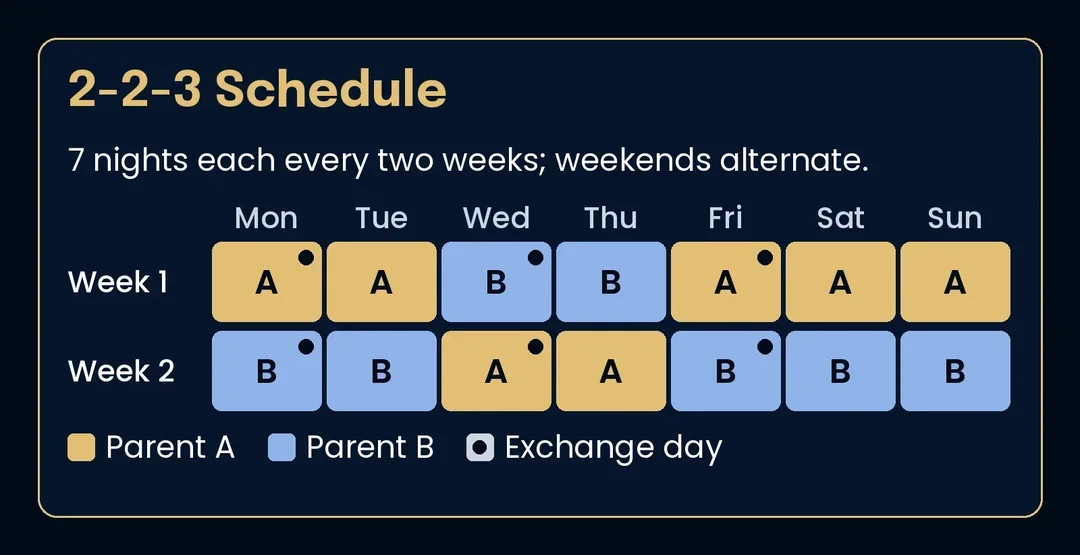
In week one, Parent A has Monday and Tuesday, Parent B has Wednesday and Thursday, and Parent A takes the weekend from Friday through Sunday. Week two is the mirror image. Each parent ends the cycle with seven overnights, and weekends alternate cleanly.
The feature that defines 2-2-3 is that weekday assignments move. A parent who has Monday and Tuesday this week has Wednesday and Thursday next week. That keeps the gaps short but means neither parent "owns" a particular weeknight.
Exchanges and Daily Logistics
Expect an exchange on Monday, Wednesday and Friday of every week, about six in a two-week cycle. How those handoffs happen shapes how well the schedule works.
School or daycare exchanges. One parent drops off in the morning and the other picks up after school. The parents rarely need to meet, which can lower friction.
Distance between homes. Because the child moves so often, both homes generally need to be within easy reach of the same school. Long commutes on alternating days wear on children and parents alike.
Two sets of essentials. Frequent movement makes duplicate clothes, chargers and school supplies close to a necessity.
Shared calendar. With weeknights shifting, a shared digital calendar helps both parents track practices, appointments and homework deadlines.
Pros and Cons by Age
Family Code sections 3020 through 3105 do not tie the 2-2-3 schedule, or any schedule, to a child's age; their only references to a child's age concern the child's wishes (sections 3030(c)(1) and 3042). The points below are common practical observations, not legal rules.
Infants and toddlers. The short gaps are the main attraction. A young child sees each parent every two or three days, which many families find easier than a week apart. Some parents of very young children begin with daytime blocks and move into a full 2-2-3 once overnights are well established; our infant and toddler schedule guide covers step-up plans.
Elementary school. The rotation can still work well, especially with school-based exchanges. The friction point tends to be activities: a Tuesday practice falls to a different parent each week, so both need to be ready to handle it.
Middle and high school. Older children often find frequent moves disruptive to homework, jobs and social life. Many families move to alternating weeks or 2-2-5-5 as a child grows. A teen's preferences may also be considered by the court, as discussed in our section 3042 article.
Summary of trade-offs
| Strengths | Drawbacks |
|---|---|
| Never more than three days away from either parent | About three transitions every week |
| Alternate weekends are equal and predictable | Weeknights change, complicating recurring activities |
| Works well with school or daycare handoffs | Requires homes close to school and to each other |
| Easy to adjust into 2-2-5-5 later | Demands steady communication between parents |
How California Courts View a High-Frequency Schedule
Family Code sections 3020 through 3105 do not name or prefer 2-2-3 or any other rotation. A court evaluating it, whether as part of an agreement or a contested request, applies the best-interest standard. Two policies sit at the center of that analysis. Family Code section 3020(b) declares a state policy of frequent and continuing contact with both parents, except when that contact would not be in the child's best interest. And section 3020(a) makes the child's health, safety and welfare the court's primary concern.
A schedule built on frequent contact fits the first policy on its face, but the number of exchanges matters if the parents' relationship is volatile. When allegations of abuse or habitual substance abuse have been raised and the court still grants custody or unsupervised visitation to that parent, section 3011(a)(5)(A) requires the order to be specific as to the time, day, place and manner of transfer of the child. Each additional exchange is another occasion the order must address.
If the parents cannot agree on the schedule, section 3170(a) requires the court to set the contested issues for mediation before a judge decides.
Variations
2-2-3 with fixed weekdays. If each parent keeps the same two weekdays every week and only the weekend alternates, the schedule becomes 2-2-5-5. See our 2-2-5-5 vs. 3-4-4-3 comparison.
Shifted exchange times. Some families exchange Sunday evening instead of Monday morning so the week starts settled.
Unequal versions. A 2-2-3 can be adapted so one parent has more weekends, producing something less than equal time.
Writing a 2-2-3 Schedule Into an Order
Under Family Code section 3048(a)(3), every custody order must clearly describe each party's custody and visitation rights. The weekday and alternate-weekend boxes on Judicial Council form FL-341 (Child Custody and Visitation (Parenting Time) Order Attachment) do not map neatly onto a flipping weekly pattern, so 2-2-3 schedules are often written in an attached page that lists the start date, which parent has week one, exact exchange times and the exchange location. If the plan changes later, a joint custody order may be modified when the child's best interest requires it under section 3087; see how to change a custody order in California. For how this rotation compares with the other equal-time options, start with our 50/50 custody schedule guide.
Making the First Month Work
The first few cycles of a 2-2-3 schedule are where most problems surface. A few practical habits help:
Print or share the first eight weeks. Seeing who has which nights for two months removes most "whose night is it?" confusion.
Agree on a packing list. Medication, school projects and comfort items should travel with the child; everything else can be duplicated.
Set a communication window. A short weekly check-in, by message or a co-parenting app, about homework, health and upcoming events keeps both homes informed.
Key Takeaways
Because weeknights change every week, parents should agree on who covers recurring activities before the schedule starts.
School and daycare handoffs can make a high-transition plan easier on everyone.
Where abuse or substance allegations are in the case, every exchange must be spelled out by time, day, place and manner.
A written order should name the start date and which parent has week one, not just "2-2-3."
FAQs
Is 2-2-3 good for a toddler?
Many parents of young children use it because no gap exceeds three days. It is a practical option, not a legal requirement, and the court decides any contested plan on the child's best interest.
How many exchanges does a 2-2-3 schedule involve?
About three a week, or six in each two-week cycle, typically on Monday, Wednesday and Friday.
Can we switch from 2-2-3 to another schedule later?
Yes. Parents can agree to a new schedule and submit it to the court, or one parent can ask the court to modify the order if the child's best interest requires it.