
Custody Schedules for Infants and Toddlers in California
Quick Answer: California's custody and visitation statutes (Family Code sections 3020 through 3105) do not set a schedule by age, so plans for babies and toddlers are built around the child's best interest. Many parents use shorter, more frequent time with each parent and a step-up plan that adds longer visits and overnights in stages as the child grows.
Why Plans for Young Children Often Look Different
Family Code sections 3020 through 3105 do not prescribe a different schedule for a child under three; their only references to a child's age concern the child's wishes (sections 3030(c)(1) and 3042). The patterns below come from the practical realities of caring for very young children, not from statute.
Infants and toddlers run on tight routines: feeding, naps, bedtime and, for many families, daycare. They also experience time differently from older children; a week can feel long to a two-year-old. For those reasons, many families start with a plan that keeps gaps between parents short and adjusts it in stages.
Common Patterns for Infants and Toddlers
Frequent daytime blocks. The child has several shorter visits a week with one parent, often three to four hours, while overnights stay in one home at first. This keeps both parents in regular contact without disrupting sleep routines.
2-2-3 rotation. Once overnights in both homes are established, some families move directly to 2-2-3, which keeps every gap at three days or less. See our 2-2-3 schedule guide.
Short-stretch rotations. Patterns such as 2-2-5-5 or alternating weeks involve longer stretches. Some families defer them until the child is older; others use them earlier when a child adapts well. See our 2-2-5-5 vs. 3-4-4-3 comparison.
Step-Up Plans
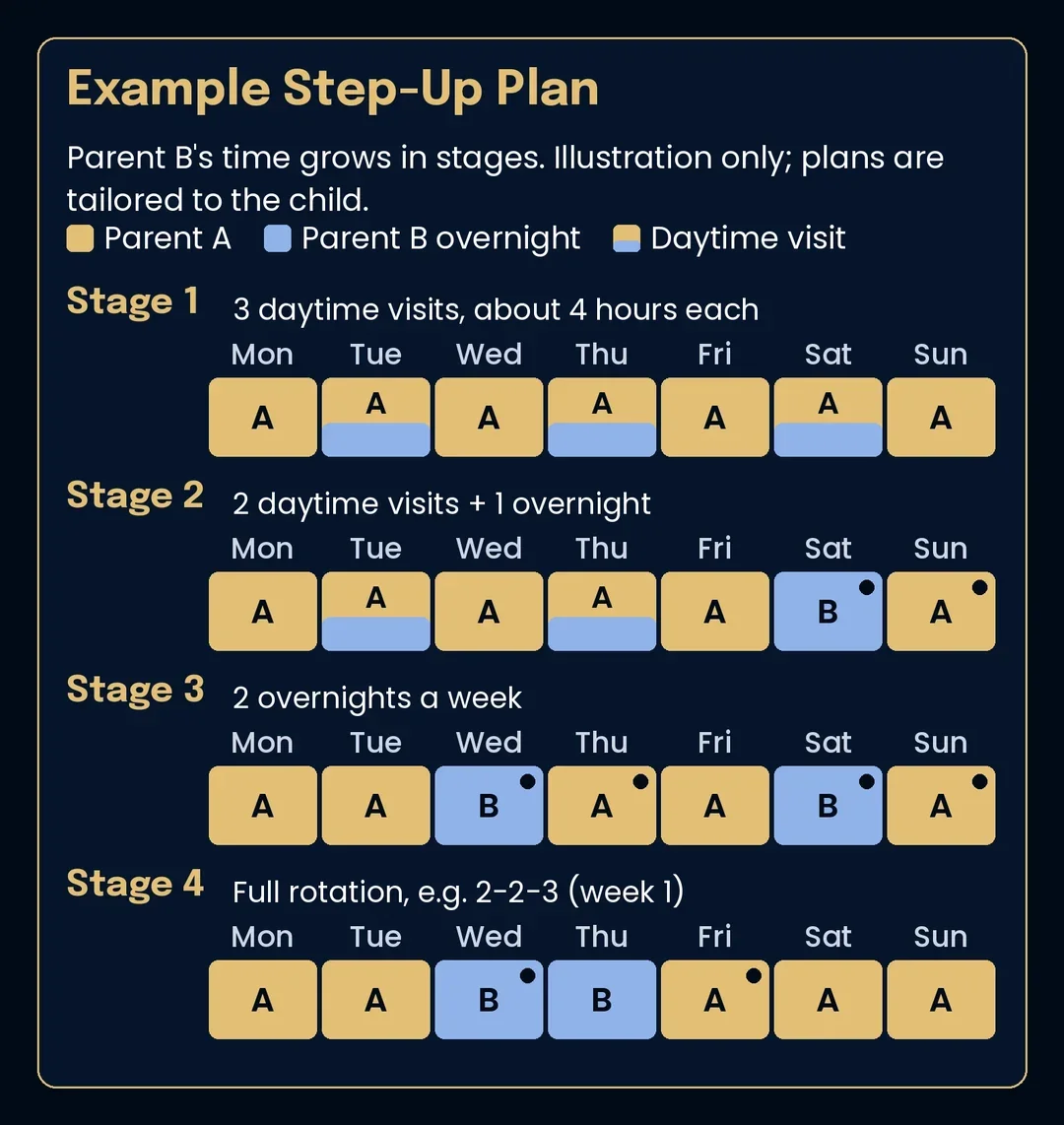
A step-up plan is a schedule that increases one parent's time in defined stages. A typical structure might look like this example:
| Stage | Example schedule |
|---|---|
| Stage 1 | Three daytime visits a week, about four hours each |
| Stage 2 | Two daytime visits plus one overnight a week |
| Stage 3 | Two overnights a week, building toward a regular rotation |
| Stage 4 | Full rotation, such as 2-2-3 |
These are illustrations, not standard stages; families and courts tailor them to the child.
A few drafting points help a step-up plan run smoothly:
Define how each stage begins. Use a fixed date, the child's age, or a condition. A date is easiest to apply; a condition needs to be specific enough that both parents know when it is met.
Keep times exact. Family Code section 3048(a)(3) requires every custody or visitation order to clearly describe each party's custody and visitation rights. That applies to every stage, not just the final one.
Plan the review. Some plans include a date to revisit the schedule. If parents later disagree, a joint custody order can be modified when the child's best interest requires it under section 3087.
Feeding, Naps and Daycare
Logistics often shape a young child's schedule more than anything else.
Breastfeeding. Parents commonly address this through visit length, timing and location, or by planning for pumped milk. These are practical arrangements to work out in the parenting plan.
Naps and bedtime. Exchange times that land just before a nap or after bedtime routines are often easier on the child.
Daycare exchanges. Dropping off and picking up at daycare can replace direct handoffs.
Routines across homes. Consistent sleep, feeding and comfort routines in both homes help the child transition.
How California Courts Approach Infant and Toddler Schedules
Because those sections contain no age-based schedule, the court applies the same best-interest standard it uses for every child.
Health, safety and welfare come first. Under Family Code section 3020(a), they are the court's primary concern.
Contact with both parents is a stated policy. Section 3020(b) declares a policy of frequent and continuing contact with both parents, except where that contact would not be in the child's best interest.
The nature and amount of contact is a listed factor. Section 3011(a)(3) directs the court to consider the nature and amount of the child's contact with both parents.
No default arrangement. Section 3040(e) establishes no preference or presumption for or against joint or sole custody.
If parents disagree on a schedule, section 3170(a) requires the court to set the contested issues for mediation. In many counties this takes the form of child custody recommending counseling; see our recommending counseling guide. The broader standard is covered in what "best interest of the child" means.
For unmarried parents, custody orders for a young child often arise in a parentage case; see how a parentage case begins in California.
Revisiting the Schedule as the Child Grows
A schedule that suits a six-month-old rarely fits a four-year-old. Parents can agree to a new plan at any time, and either parent can ask the court to modify a joint custody order when the child's best interest requires it. See how to change a custody order in California. For a full comparison of equal-time rotations to move into later, see our 50/50 custody schedule guide.
A Sample Week in Stage 2
To make the step-up idea concrete, here is one illustration of what a Stage 2 week might look like when Parent B is adding overnights:
| Mon | Tue | Wed | Thu | Fri | Sat | Sun | |
|---|---|---|---|---|---|---|---|
| Parent B | — | 3–7 p.m. | — | 3 p.m.–Fri 9 a.m. | — | 10 a.m.–2 p.m. | — |
All other time is with Parent A. In this example, Parent B has one overnight and two daytime visits, and the longest gap without seeing either parent is about two days. This is an example only, not a recommended or standard schedule.
Key Takeaways
Each stage of a step-up plan needs a clear start date or trigger and exact times.
Exchange times built around naps and bedtime tend to make transitions easier.
Daycare can serve as a neutral exchange point that avoids direct handoffs.
The nature and amount of each parent's contact with the child is a factor courts consider by statute.
FAQs
Can a father have overnights with a newborn in California?
Family Code sections 3020 through 3105 set no age at which overnights begin. A contested schedule is decided on the child's best interest, with the child's health, safety and welfare as the court's "primary concern" under section 3020(a).
What is a step-up parenting plan?
A schedule that increases a parent's time in defined stages, often starting with daytime visits and adding overnights over time.
Do we have to go to mediation over a baby's schedule?
If custody or visitation is contested, the court sets the contested issues for mediation before deciding them.
How do we handle breastfeeding in a custody schedule?
Parents usually address it through the timing, length and location of visits or by planning for pumped milk. The parenting plan should spell out what the parents agree.