
50/50 Custody Schedules in California: How the Common Rotations Work
Quick Answer: California has no default 50/50 custody rule. A court may order any parenting plan that serves the child's best interest, and when parents agree to joint custody the law presumes that arrangement is in the child's best interest. Families who want equal time most often choose a 2-2-3, alternating-weeks (7-7), 2-2-5-5 or 3-4-4-3 rotation.
What "50/50" Means Under California Law
"50/50" is everyday shorthand, not a legal term. The Family Code speaks of joint physical custody, and it defines that phrase as each parent having "significant periods of physical custody," shared in a way that assures the child frequent and continuing contact with both parents. Nothing in that definition requires an exact even split of overnights. A plan can be joint physical custody at 60/40 or 55/45, and a plan that happens to land at precisely half and half is simply one version of it.
Physical custody (where the child lives day to day) is also separate from legal custody, which is the shared right and responsibility to make decisions about the child's health, education and welfare. Parents can share legal custody while dividing physical time unevenly, or the reverse. Our article on joint legal custody, joint physical custody and visitation covers those definitions in depth, so this guide focuses on the calendar itself.
Is There a 50/50 Presumption in California?
No. Family Code section 3040(e) says the custody statute establishes "neither a preference nor a presumption for or against" joint legal custody, joint physical custody or sole custody. Instead, it gives the court and the family "the widest discretion" to choose a parenting plan that is in the child's best interest.
There is one presumption worth knowing. Under section 3080, when parents have agreed to joint custody, or agree to it in open court, the law presumes joint custody is in the child's best interest, subject to the best-interest factors in section 3011. In practice, that means an agreement between parents carries real weight, while a contested request for equal time is decided on the facts like any other custody question.
The Four Common Equal-Time Rotations
Each of the schedules below gives each parent seven overnights in every 14-day cycle. What separates them is how often the child changes homes and how long the child goes without seeing each parent.
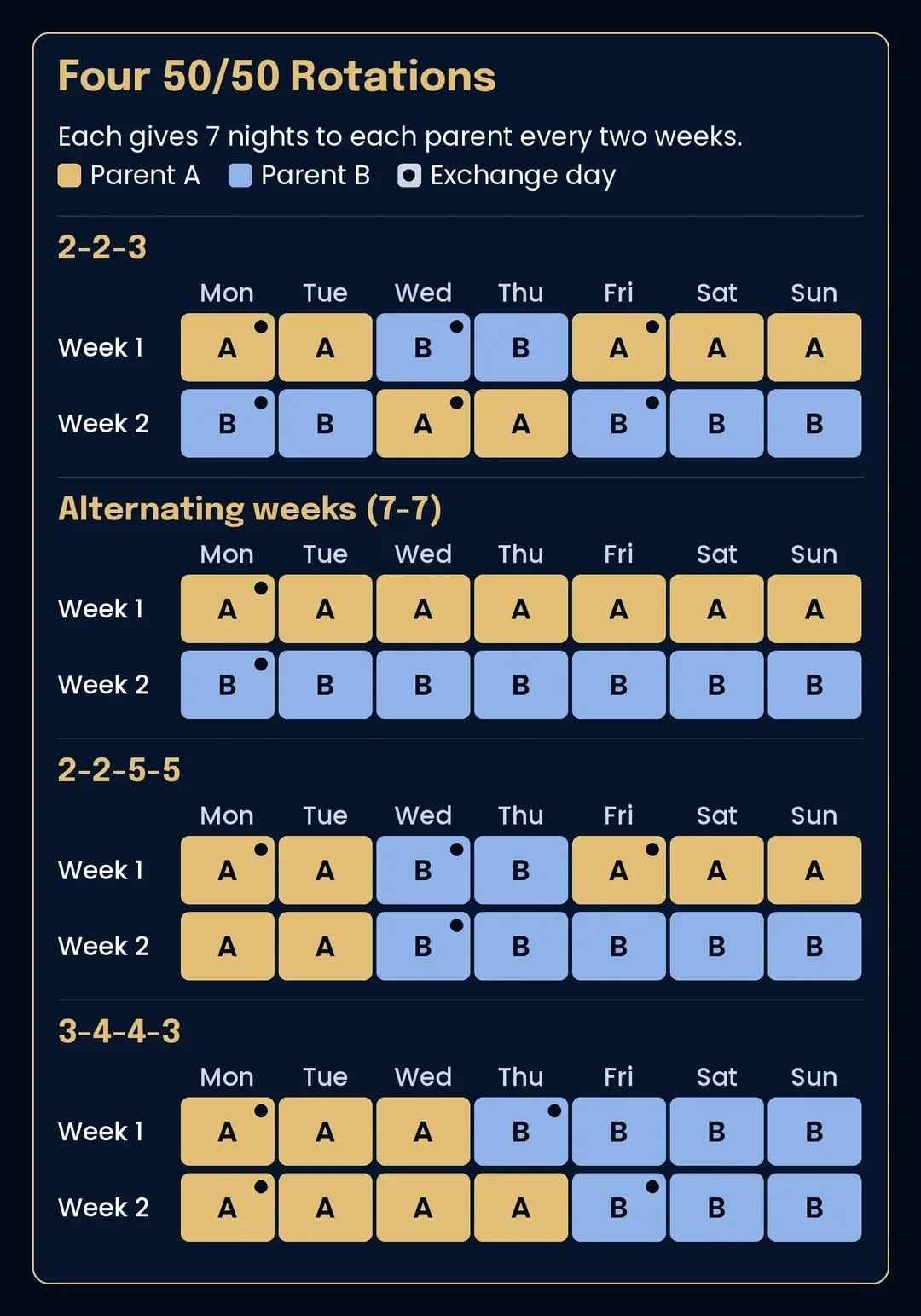
| Rotation | How the 14 days fall | Exchanges per 2 weeks | Longest stretch away from a parent |
|---|---|---|---|
| 2-2-3 | 2 days with A, 2 with B, 3 with A; next week reverses | about 6 | 3 days |
| Alternating weeks (7-7) | 7 days with A, then 7 with B | 2 | 7 days |
| 2-2-5-5 | A always has Mon–Tue, B always has Wed–Thu, weekends alternate | 4 | 5 days |
| 3-4-4-3 | 3 days with A, 4 with B; next week 4 with A, 3 with B | 4 | 4 days |
2-2-3. Weekday pairs shift each week and weekends alternate. Time apart never runs longer than three days, which is why parents of younger children often look at it first. The cost is frequent transitions, so it tends to suit parents who live close together and can handle many handoffs calmly. See our full guide to the 2-2-3 schedule.
Alternating weeks. The child spends a full week in each home, usually switching on the same day. It is the easiest plan to remember and has the fewest exchanges, but a week is a long gap for some children. Many families add a midweek dinner or overnight with the off-week parent. More in our week-on/week-off guide.
2-2-5-5 and 3-4-4-3. Both are middle grounds. 2-2-5-5 locks each parent into the same weekdays every week, which helps with standing lessons and practices. 3-4-4-3 has fewer exchanges but an uneven weekly split that evens out over two weeks. We compare them in 2-2-5-5 vs. 3-4-4-3.
Choosing a Rotation by Age
Family Code sections 3020 through 3105, the core custody and visitation provisions, do not assign a schedule to any age group; their only references to a child's age concern the child's wishes (sections 3030(c)(1) and 3042). The considerations below are practical points families and professionals commonly weigh, not legal rules.
Infants and toddlers. Very young children often do better with shorter gaps between parents, so frequent-contact plans or step-up plans that add overnights over time are common. Feeding, naps and daycare hours shape exchange times. Our guide to custody schedules for infants and toddlers goes through step-up stages.
School-age children. School-day logistics start to drive the choice. Exchanges at school pickup reduce face-to-face handoffs, and fixed weekdays (2-2-5-5) make activities easier to schedule. Distance from school matters more as the child's week fills up.
Teenagers. Many teens prefer fewer moves, which points toward alternating weeks, and their own commitments can make a rigid rotation impractical. A teen's views can also count legally: section 3042 requires the court to consider and give due weight to the wishes of a child who is of sufficient age and capacity to form an intelligent preference. A child 14 or older who wants to address the court must be permitted to, unless the court finds that would not be in the child's best interest. Our section 3042 article explains how that works.
How a California Court Evaluates a Proposed Schedule
When parents cannot agree, the judge measures any proposed rotation against the best-interest standard. A few principles frame that analysis:
Health, safety and welfare come first. Section 3020(a) makes them the court's primary concern.
Frequent and continuing contact is state policy. Section 3020(b) declares a policy of ensuring children have frequent and continuing contact with both parents, except when that contact would not be in the child's best interest.
Safety controls when the two conflict. Under section 3020(c), if those policies collide, the order must ensure the child's health, safety and welfare and the safety of all family members.
Listed factors. Section 3011 directs the court to consider, among other things, the child's health, safety and welfare; any history of abuse; the nature and amount of contact with both parents; and habitual substance abuse.
The broader standard is covered in what "best interest of the child" means in California.
Before a judge decides a contested schedule, the case goes to mediation. Section 3170(a) requires the court to set contested custody or visitation issues for mediation. Depending on the county, that process may be child custody recommending counseling, described in our recommending counseling guide.
Finally, a shared schedule can be revisited. Under section 3087, a joint custody order may be modified or terminated when the child's best interest requires it. The process is outlined in how to change a custody order in California.
Putting the Schedule Into an Order
A rotation only works if the order describes it clearly. Section 3048(a)(3) requires every custody or visitation order to contain a clear description of each party's custody and visitation rights. Judicial Council form FL-341, the Child Custody and Visitation (Parenting Time) Order Attachment, has spaces for weekend, alternate-weekend and weekday parenting time, and an option to attach a separate page for schedules that do not fit the boxes.
Two optional attachments often travel with it:
FL-341(C), Children's Holiday Schedule Attachment. It lists holidays and school breaks with columns for every year, even years and odd years. The form notes that, unless specifically ordered, the holiday schedule has priority over regular parenting time. See our holiday schedule guide.
FL-341(D), Additional Provisions—Physical Custody Attachment. It covers items such as notice of address changes, notice before a child's planned move, a right of first option for child care and phone contact, including an option for scheduled calls and a term that no one may "listen to, monitor, or interfere with the calls." We cover call schedules in our every-other-weekend and long-distance guides. Related reading: the right of first refusal in a California parenting plan.
Write in exact days, start and end times, and the exchange location. A schedule named only "2-2-3" leaves room for argument about which parent starts and when the week begins.
Shared time also connects to child support. California's guideline formula in Family Code section 4055 includes the approximate percentage of time the higher earner has primary physical responsibility for the children, so a schedule change can affect the guideline figure. Our child and spousal support overview covers the rest of the formula.
Practical Questions to Settle Before Choosing
Before comparing rotations, it helps to answer a few concrete questions as a household. These are planning points, not legal requirements.
How far apart are the homes, and how far is each from school? High-transition schedules such as 2-2-3 depend on short drives. If one home is 40 minutes from school in Bay Area traffic, a rotation with fewer school-day exchanges may be more realistic.
What do work schedules look like? A parent who travels every other week, or works weekend shifts, may fit some rotations far better than others. Build the schedule around the weeks that actually happen, not an idealized calendar.
How do the parents communicate? Every exchange requires coordination. Parents who struggle to communicate often prefer fewer handoffs, school-based exchanges, or a written protocol for messages. A parenting coordinator can also help some families; see what a parenting coordinator does.
What does the child's week already look like? Standing activities, therapy appointments and religious school all point toward rotations with fixed weekdays.
How will the plan change over time? A schedule chosen for a toddler will rarely fit a teenager. Building in a review date, or simply expecting to revisit the plan, reduces pressure to get it perfect on day one.
Writing the answers down before negotiating tends to narrow the options quickly.
Key Takeaways
Equal-time rotations differ mainly in transition frequency and the longest gap away from each parent, so start with those two numbers.
A shared plan does not have to split overnights exactly in half to be joint physical custody.
Holiday terms and extra provisions such as first option for child care should be drafted together with the regular rotation.
Parenting time is an input in the guideline child support formula, so a schedule change can have financial effects.
FAQs
What is the most common 50/50 custody schedule?
Family Code sections 3020 through 3105 do not name or prefer any particular rotation, and section 3040(e) gives the court and the family "the widest discretion to choose a parenting plan that is in the best interest of the child." Alternating weeks is the simplest to run, while 2-2-3 keeps the time apart from either parent the shortest. Which is "best" depends on distance between homes, work hours and the child's age.
Can a judge order 50/50 if one parent objects?
It is possible. The court has wide discretion and decides on the child's best interest, without a preference for or against joint physical custody. The joint-custody presumption in section 3080 applies only when parents agree.
Does my child get a say in the schedule?
A child with sufficient age and capacity to form an intelligent preference must have those wishes considered and given due weight. A child 14 or older who wants to address the court is permitted to unless the court finds it is not in the child's best interest.
Do we have to use form FL-341?
FL-341 is an optional form, but the order must clearly describe each party's custody and visitation rights. Many families use FL-341 with a written attachment for more detailed schedules.