
Week-On/Week-Off (7-7) Custody in California: Pros, Cons and Variations
Quick Answer: In a week-on/week-off schedule, the child lives with one parent for seven days and then with the other for seven, usually switching on the same day each week. It has the fewest exchanges of any equal-time plan, but each parent goes a full week without overnights unless a midweek visit is added.
How Alternating Weeks Work
The rotation is as simple as custody schedules get. Parent A has the child for one full week, Parent B has the next, and the cycle repeats.
| Mon | Tue | Wed | Thu | Fri | Sat | Sun | |
|---|---|---|---|---|---|---|---|
| Week 1 | A | A | A | A | A | A | A |
| Week 2 | B | B | B | B | B | B | B |
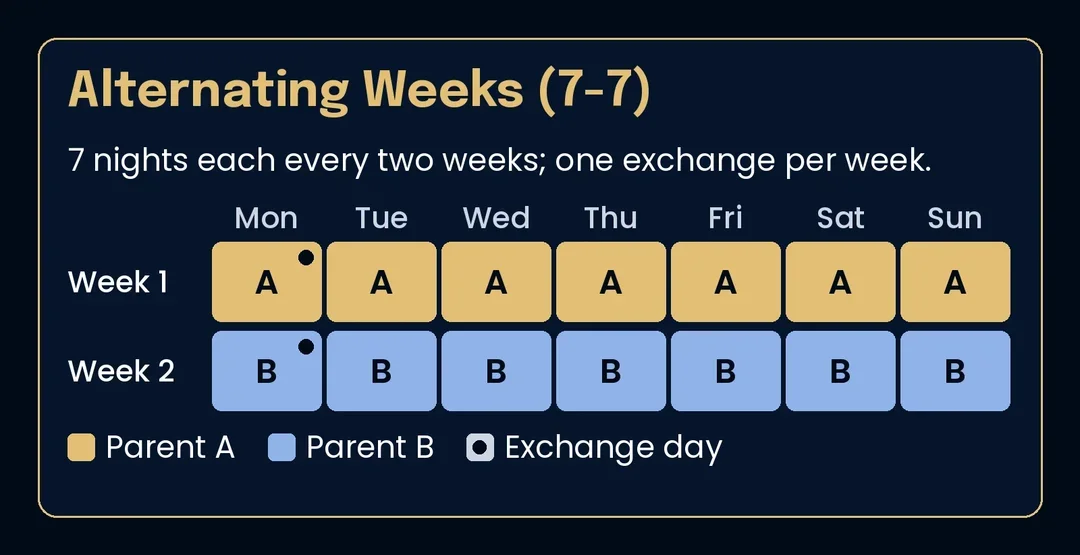
The main design choice is the exchange day. The most common options:
Friday after school. The incoming parent picks up at school, so the parents do not meet, and the new week begins with a weekend together.
Sunday evening. The child settles in before the school week starts. This requires a direct handoff unless a neutral location is used.
Monday at school. Like Friday pickup, it avoids face-to-face exchanges, and each parent's week ends with a full weekend.
Common Variations
A full week is a long time for some children, so many families adjust the basic pattern.
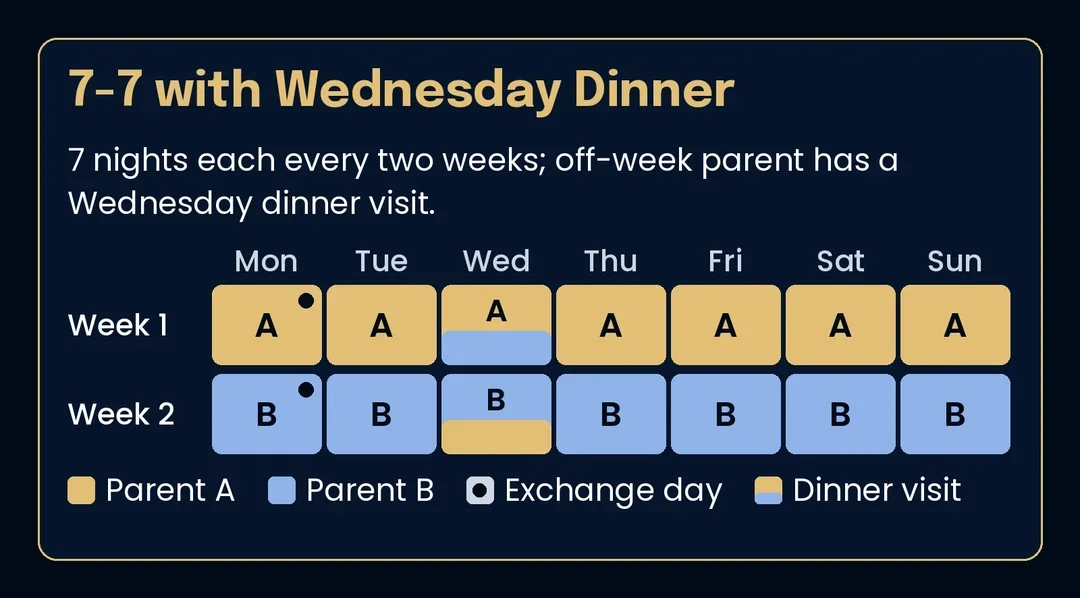
Midweek dinner. The off-week parent has the child for a few hours on a set weeknight, often Wednesday. Overnights stay equal and the longest gap without seeing a parent drops to three or four days.
Midweek overnight. The off-week parent has one overnight in the middle of the other parent's week. Over 14 days this produces a 5-2-2-5 feel. It still divides time evenly if both parents get the same midweek overnight in their off week.
Split weekends. Less common, but some families exchange midway through the weekend so each parent has some weekend time every week.
Pros and Cons by Age
Family Code sections 3020 through 3105 do not set an age for alternating weeks; their only references to a child's age concern the child's wishes (sections 3030(c)(1) and 3042). The following are practical considerations families commonly weigh.
Infants and toddlers. A week is a long stretch away from a parent for a very young child, and many families choose a shorter-gap rotation such as 2-2-3 at this stage. See our guide to schedules for infants and toddlers.
Elementary school. Alternating weeks often becomes workable here, especially with a midweek dinner. Children can track the routine easily: "this week at Mom's, next week at Dad's."
Teenagers. Many teens prefer it. Fewer moves mean less packing and more continuity for homework, sports and jobs. A teen's views on the schedule can also matter legally, as discussed in our section 3042 article.
| Strengths | Drawbacks |
|---|---|
| Only one exchange a week | Seven days without overnights with one parent |
| Easy for children to understand | Can feel long for young children |
| Workable even if homes are farther apart | Each parent carries the full weekly load during their week |
| Fewer occasions for conflict at handoffs | Midweek events in one parent's week may exclude the other |
How California Courts View Alternating Weeks
The Family Code does not prefer alternating weeks over any other arrangement. Section 3040(e) states that the custody statute creates no preference or presumption for or against joint physical custody or sole custody, leaving the court "the widest discretion" to choose a plan in the child's best interest.
Equal weeks plainly meet the definition of joint physical custody in section 3004, which requires that each parent have "significant periods of physical custody." A court weighing a contested proposal still applies the best-interest factors, including the nature and amount of contact with both parents under section 3011(a)(3), and the state policy of frequent and continuing contact in section 3020(b). A midweek visit is one way parents address the length of the gap.
When parents agree to joint custody, section 3080 presumes it is in the child's best interest, subject to section 3011. When they do not, the case is set for mediation under section 3170(a).
Layering Holidays on a Weekly Rotation
Weekly schedules raise a predictable question: what happens when a holiday falls during the other parent's week? Judicial Council form FL-341(C), the Children's Holiday Schedule Attachment, answers it in a note on the form: unless specifically ordered, a child's holiday schedule order has priority over the regular parenting time. In practice, the weekly rotation pauses for the holiday and then resumes as scheduled. Our holiday custody schedule guide walks through the form.
Summer is the other common adjustment. Some families keep alternating weeks year-round, while others switch to two-week blocks in summer to allow vacations. Whatever the choice, the order should say which applies. Travel outside California may also need the other parent's written permission or a court order if the custody order includes that restriction; see traveling with your child after a California divorce.
Writing It Into an Order
Every custody order must contain a clear description of each party's rights under section 3048(a)(3). For alternating weeks, that means naming the start date, which parent has the first week, the exchange day and time, and the location. Any midweek visit should have its own day and hours. For a side-by-side view of the other equal-time options, see our 50/50 custody schedule guide.
Communication on a Weekly Rotation
Because each parent has the child for a full week, information has to cross over at every exchange: homework due dates, medical updates, permission slips and upcoming events. Many families use a brief written handoff note or a shared co-parenting app so the incoming parent starts the week informed. Our guide to communication between parents during divorce offers practical approaches. A clear protocol also helps when one parent needs child care during their week; some plans include a right of first refusal so the other parent is offered that time first.
Key Takeaways
The exchange day is the most important design choice; school-day exchanges avoid direct handoffs.
A midweek dinner keeps overnights equal while shortening the longest gap.
Summer can follow the same rotation or switch to longer blocks, but the order should say which.
Parents who agree on joint custody benefit from a statutory presumption that it is in the child's best interest.
FAQs
At what age does week-on/week-off work?
Family Code sections 3020 through 3105 do not set an age for it; their age references concern the child's wishes. Many families use it once a child is in school; for younger children, parents often choose a rotation with shorter gaps. A contested plan is decided on the child's best interest.
Does week-on/week-off mean we have joint physical custody?
Equal weeks fit the statutory definition of joint physical custody, which requires significant periods with each parent. The custody designation in your order still controls how it is labeled.
How do holidays work with a weekly schedule?
Typically through a separate holiday schedule, often on form FL-341(C). Unless the order says otherwise, holiday time takes priority over the regular weekly rotation.