
Holiday Custody Schedules in California: Using Form FL-341(C)
Quick Answer: Most California holiday schedules alternate holidays between parents in odd and even years, split a holiday into two halves, or give a holiday to the same parent every year. Judicial Council form FL-341(C) lists common holidays and school breaks, and unless specifically ordered otherwise, the holiday schedule takes priority over regular parenting time.
Three Common Ways to Divide Holidays
Alternate by year. One parent has Thanksgiving in odd-numbered years and the other in even-numbered years, and the pattern flips for other holidays. This is the most common approach because it is easy to apply and fair over time.
Split the holiday. The child spends part of the day with each parent, for example Christmas Eve to Christmas morning with one and Christmas afternoon onward with the other. Longer breaks are often split into halves. This works best when homes are close.
Fixed every year. A holiday goes to the same parent every year, often where it matters more to one family than the other, or for Mother's Day and Father's Day.
Many families combine all three in one schedule.
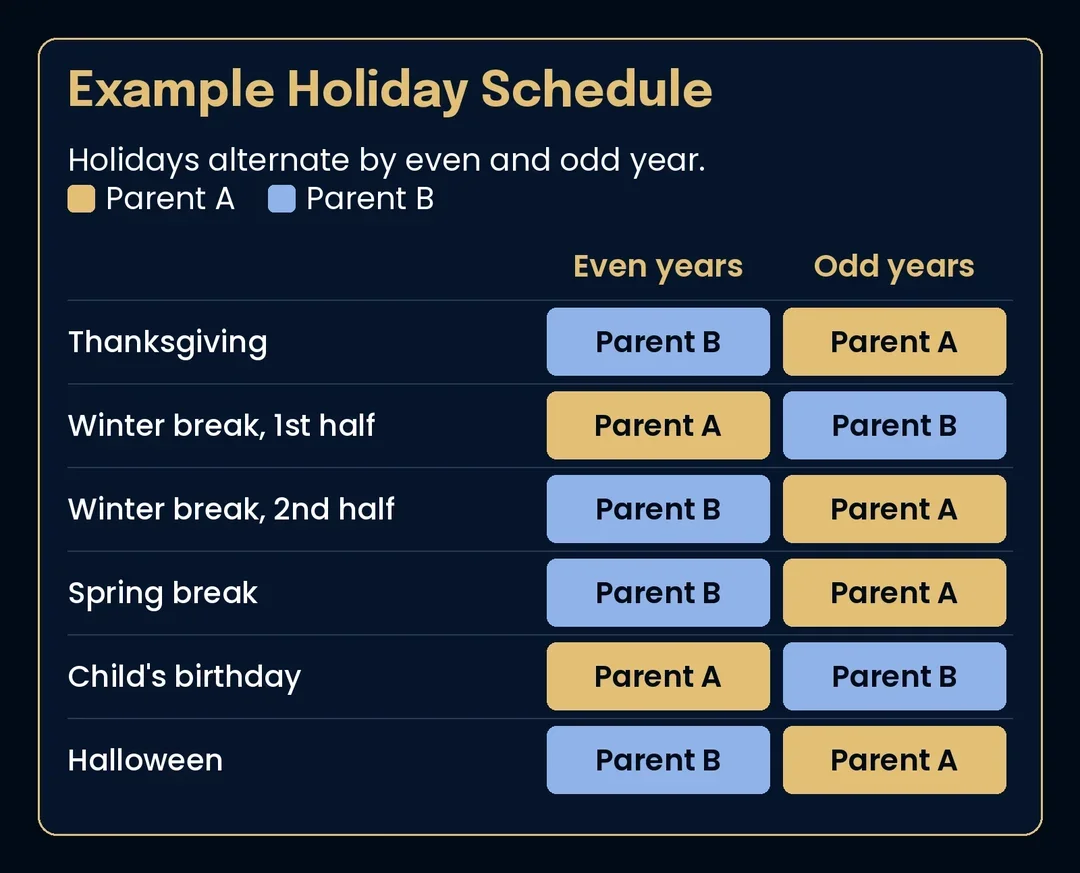
Using Form FL-341(C)
The Judicial Council's Children's Holiday Schedule Attachment, form FL-341(C), is an optional form that can be attached to a custody order or agreement. It provides:
A list of holidays and breaks. It includes New Year's Eve and Day, Martin Luther King Jr. weekend, Presidents' Day weekend, Presidents' week and spring break (each split into halves), Mother's Day, Memorial Day weekend, Father's Day, July 4th, summer break, Labor Day weekend, Columbus Day weekend, Halloween, Veterans Day, Thanksgiving Day and weekend, the December/January school break, and birthdays for children and parents.
Year columns. For each holiday, you write which party has it every year, in even-numbered years, or in odd-numbered years.
Times. A column for when each holiday starts and ends, with a default start and end time for single-day holidays unless noted.
Room for others. Additional lines for holidays not listed and for breaks at year-round schools.
The form's revision currently posted on courts.ca.gov is dated July 1, 2016. The main custody attachment, form FL-341 (Child Custody and Visitation (Parenting Time) Order Attachment), has an item for the holiday schedule and points to FL-341(C) as one way to set it out.
How Holidays Interact With the Regular Schedule
FL-341(C) states that, unless specifically ordered, a child's holiday schedule order has priority over the regular parenting time. Practically, the regular rotation pauses for the holiday and resumes afterward.
Questions to answer in writing:
Does the regular schedule resume where it would have been, or restart? Most families resume as if the holiday had not occurred.
Does a holiday weekend include Monday? Three-day weekends need defined start and end times.
What about summer? Summer is often a separate block, such as two weeks with each parent for vacation, with the regular rotation in between.
If your regular schedule is week-on/week-off, see our alternating-weeks guide for how holidays layer on top.
Pros and Cons by Age
Family Code sections 3020 through 3105 do not set holiday schedules by age; their only references to a child's age concern the child's wishes (sections 3030(c)(1) and 3042). These are practical considerations.
Infants and toddlers. Splitting a holiday day can be easier on a young child than a long holiday absence from a primary caregiver, but frequent transitions on one day can also be tiring. Nap and bedtime routines matter.
School-age children. Alternating years works well, and children can understand "this Thanksgiving with Mom, next with Dad." Splitting long breaks keeps each parent involved.
Teenagers. Teens often have their own holiday plans, travel teams or jobs. Building in flexibility, or asking for their input, can reduce conflict. A teen's preferences may be considered under Family Code section 3042.
| Method | Strengths | Drawbacks |
|---|---|---|
| Alternate by year | Simple; whole holiday with one parent | A parent misses the holiday every other year |
| Split the holiday | Child sees both parents each year | More transitions; needs nearby homes |
| Fixed every year | Honors traditions | Can feel unequal without trade-offs |
Travel During Holidays
Holiday travel raises its own issues. An order may require written permission from the other parent or a court order before taking a child out of California or out of specified counties. Our article on traveling with your child after a California divorce covers permissions and itineraries. Where there are concerns about a child being kept abroad, Family Code section 3048(b) lists measures the court must consider if it finds a need for preventive measures, such as requiring a travel itinerary or copies of round-trip airline tickets.
How California Courts Approach Holiday Schedules
Holiday time is part of the overall custody and visitation order and is decided by the same best-interest standard. Family Code section 3048(a)(3) requires every custody or visitation order to contain a clear description of each party's rights, which is why defined start and end times matter. If parents cannot agree, contested custody and visitation issues are set for mediation under section 3170(a).
Family Code section 290 provides that "a judgment or order made or entered pursuant to this code may be enforced by the court by execution, the appointment of a receiver, or contempt, or by any other order as the court in its discretion determines from time to time to be necessary." That section applies to judgments and orders, so a holiday arrangement the parents want the court to be able to enforce on that basis needs to be made or entered as a court order. For how a holiday schedule fits with the regular rotation, see our 50/50 custody schedule guide.
Common Holiday Schedule Pitfalls
Most holiday disputes trace back to a few gaps in the written schedule:
Undefined times. "Christmas" without a start and end time invites argument over Christmas Eve.
Floating holidays. Thanksgiving weekend and Monday holidays move each year; specify whether a weekend runs Wednesday, Thursday or Friday through Sunday or Monday.
School calendars. Break dates differ between districts and private schools; tie breaks to the child's school calendar.
Birthdays on school days. Decide whether a birthday means a dinner, an overnight or the nearest weekend.
Mother's Day and Father's Day. These are commonly fixed every year; say so explicitly.
Planning these details in advance usually prevents the most common conflicts.
Key Takeaways
Every holiday entry needs a start and end day and time to avoid disputes.
Thanksgiving weekend, winter break and spring break can each be split into halves.
Birthdays for children and parents can be scheduled on the same attachment.
Summer is usually handled as its own block separate from the regular rotation.
FAQs
Do holidays override the normal custody schedule?
According to FL-341(C), yes, unless the order specifically says otherwise.
Is form FL-341(C) required?
No. It is approved for optional use. Parents can describe holidays in another attachment, but the order must still clearly describe each party's rights.
Can we change the holiday schedule by agreement?
Parents can agree to swap holidays. Family Code section 290 gives the court enforcement powers over "a judgment or order made or entered pursuant to this code," so a change the parents want the court to be able to enforce should be made into a court order.