
Every-Other-Weekend Custody in California: How Many Days Is It?
Quick Answer: A plain every-other-weekend schedule, Friday school pickup to Monday school drop-off, gives the non-primary parent three overnights every two weeks: about 78 overnights a year, or roughly 21% of overnights. Adding a Wednesday overnight each week, from Wednesday school pickup to Thursday school drop-off, brings it to five of every 14 nights, about 130 a year or roughly 36%. Holiday and summer time can change those totals considerably.
What an Every-Other-Weekend Schedule Looks Like
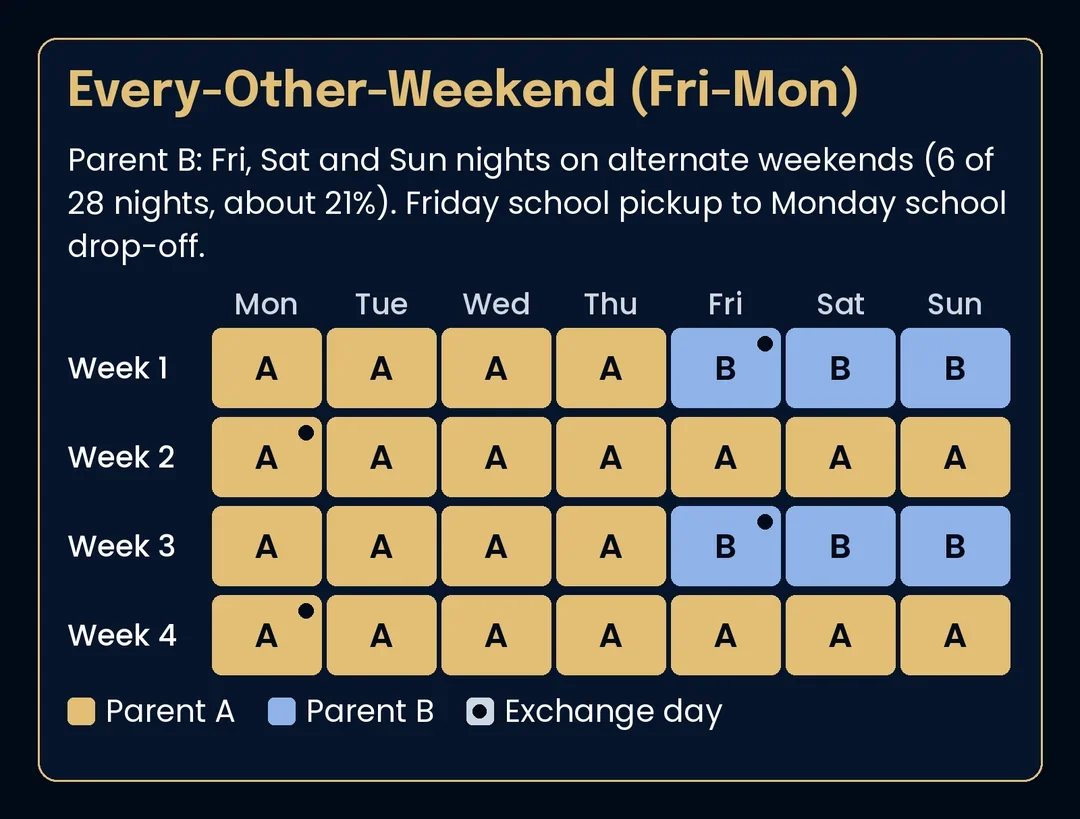
In its basic form, the child lives primarily with one parent, and the other parent has the child on alternating weekends, typically from Friday school pickup to Monday school drop-off, which covers Friday, Saturday and Sunday nights.
| Mon | Tue | Wed | Thu | Fri | Sat | Sun | |
|---|---|---|---|---|---|---|---|
| Week 1 | A | A | A | A | B | B | B |
| Week 2 | A | A | A | A | A | A | A |
Each weekend ends at Monday school drop-off, when Parent A resumes care.
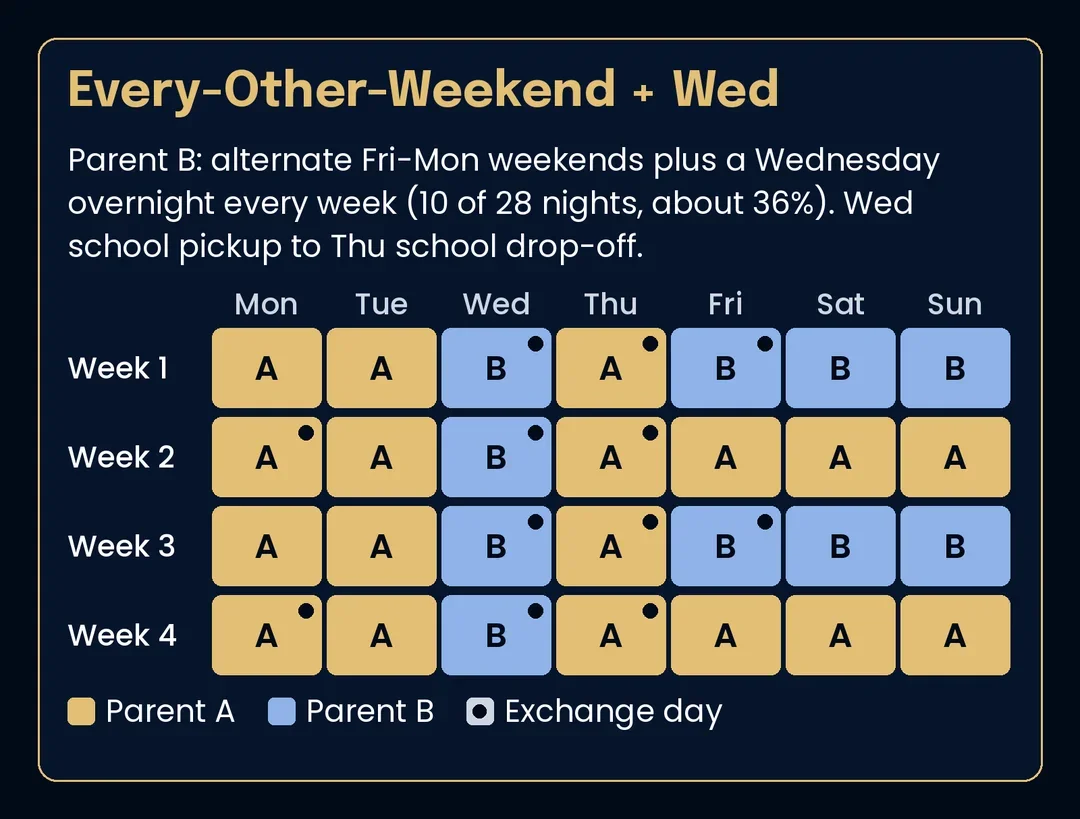
Families often expand it with a weekly midweek overnight, such as Wednesday school pickup to Thursday school drop-off, or extended summer time.
The Day Count
These figures are arithmetic, not legal categories. They count overnights, which is how many parents measure time; other counting methods produce different numbers.
| Arrangement | Overnights per 14 days | Approx. overnights per year | Approx. share |
|---|---|---|---|
| Alternate weekends, Friday school pickup to Monday school drop-off | 3 | 78 | 21% |
| Alternate weekends + Wednesday overnight every week (Wednesday school pickup to Thursday school drop-off) | 5 | 130 | 36% |
| Variation: alternate weekends ending Sunday evening | 2 | 52 | 14% |
| Variation: weekends ending Sunday evening + weekly midweek overnight | 4 | 104 | 29% |
How it works: 52 weeks yields 26 alternate weekends. A weekend from Friday school pickup to Monday school drop-off has three overnights (Friday, Saturday and Sunday), so 26 × 3 = 78, or 3 of every 14 nights. A Wednesday overnight every week adds 2 nights per two-week cycle (52 a year), for 5 of 14 nights, or 130. Ending the weekend Sunday evening drops Sunday night (26 × 2 = 52).
Holidays, school breaks and summer vacation will move these numbers, sometimes substantially, so a full-year count needs the holiday schedule as well.
"Alternate Weekends" vs. "1st, 3rd and 5th Weekends"
These sound similar but are different schedules. Judicial Council form FL-341, the Child Custody and Visitation (Parenting Time) Order Attachment, has separate options for each:
Alternate weekends run on a strict every-other-week pattern from a start date.
Numbered weekends (for example, the 1st, 3rd and 5th of each month) reset every month. FL-341 notes that the first weekend of the month is the first weekend with a Saturday, and it provides ways to handle fifth weekends, either alternating them or assigning them by odd and even months.
Because some months have five weekends, numbered weekends sometimes produce back-to-back weekends with the same parent. The difference is worth confirming before signing an agreement.
Pros and Cons by Age
Family Code sections 3020 through 3105 do not assign this schedule to a particular age; their only references to a child's age concern the child's wishes (sections 3030(c)(1) and 3042). These are common practical considerations.
Infants and toddlers. Two weeks between visits is a long gap for a very young child, so families with babies often add short, frequent visits or use a step-up plan instead. See our infant and toddler guide.
School-age children. A primary home on school nights can simplify homework and routines. A weekly Wednesday overnight keeps the other parent involved in the school week.
Teenagers. Weekend jobs, sports and social plans can crowd out alternating weekends. Many families build in flexibility or shift the pattern as the teen's schedule changes.
| Strengths | Drawbacks |
|---|---|
| One home base during the school week | Long gaps for the non-primary parent |
| Few exchanges | Limited involvement in school-week life |
| Simple to follow | Weekend parent may have little routine time |
How California Courts Approach a Primarily One-Home Plan
Every-other-weekend is not California's "standard" schedule. Family Code section 3040(e) creates no preference or presumption for or against sole or joint custody and gives the court "the widest discretion" to choose the plan that serves the child.
When a child primarily lives with one parent, the order may designate sole physical custody, which section 3007 defines as the child residing with and being supervised by one parent, "subject to the power of the court to order visitation." Under section 3100(a), when the court makes an order under the joint custody chapter, it must grant reasonable visitation to a parent if visitation is shown to be in the child's best interest.
When the court grants custody to one parent, section 3040(a)(1) directs it to consider, among other factors, which parent is more likely to allow the child frequent and continuing contact with the other parent. And the state's policy, set out in section 3020(b), favors frequent and continuing contact with both parents except where that contact would not be in the child's best interest.
How Parenting Time Connects to Child Support
California's guideline child support formula, in Family Code section 4055, includes a variable for the approximate percentage of time the higher-earning parent has primary physical responsibility for the children. A schedule's timeshare is therefore one input to the guideline amount, alongside both parents' incomes. Our child and spousal support overview covers the full calculation.
Expanding Time Later
Parenting plans often change as children grow. Parents can agree to add time, or one parent can ask the court to modify the order; see how to change a custody order in California. If a more even split is the goal, our 50/50 custody schedule guide compares the common equal-time rotations.
Phone and Video Calls Between Weekends
With eleven days between weekends in the plain schedule, a regular call can keep the other parent part of the child's ordinary week. Family Code sections 3020 through 3105 do not give either parent a right to a daily call or set call length; section 3100(f) does recognize "virtual visitation," meaning "use of audiovisual electronic communication tools to provide contact between a parent and their children as part of a parenting plan or custody order."
On the optional Additional Provisions—Physical Custody Attachment (form FL-341(D)), item 6 ("Phone contact between parties and children") offers three choices: telephone access "at reasonable times, for reasonable durations"; a specific schedule for which "the custodial parent must make the child available"; and a term that "No party or any other third party may listen to, monitor, or interfere with the calls."
When writing a schedule, parents typically settle a call window (for example, Tuesday and Thursday at 7 p.m.), a typical length, which parent starts the call and how a missed call is handled.
Making Weekend Time Count
Every-other-weekend time is limited, so families often look for ways to use it well and to stay connected between weekends:
Start the weekend at school pickup so the child moves directly into the weekend parent's care without a separate handoff.
Keep a consistent routine in the weekend home, such as a regular meal, activity or bedtime, so it feels like a second home rather than a visit.
Add phone or video contact between weekends at set times.
Coordinate on homework and activities so weekend time is not consumed by catch-up.
Key Takeaways
"Alternate weekends" and "1st, 3rd and 5th weekends" produce different calendars, so check which one an order uses.
Running each weekend from Friday school pickup to Monday school drop-off gives 3 of every 14 nights (about 21%), and adding a Wednesday overnight every week brings it to 5 of 14 (about 36%).
California law favors frequent and continuing contact with both parents, which midweek time helps support.
The weekend timeshare is one input into guideline child support.
FAQs
Is every-other-weekend the standard schedule in California?
No. Family Code sections 3020 through 3105 do not make it a default, and section 3040(e) gives the court and the family "the widest discretion to choose a parenting plan that is in the best interest of the child."
What percentage is every-other-weekend custody?
About 21% of overnights (3 of every 14) when weekends run from Friday school pickup to Monday school drop-off, before holidays, summer or midweek time. Adding a Wednesday overnight every week brings it to 5 of 14, about 36%.
Does every-other-weekend custody affect child support?
The guideline formula uses each parent's approximate share of time with the children, so the timeshare is one factor in the calculation along with both incomes.