
Long-Distance Custody Schedules in California
Quick Answer: When parents live far apart, custody schedules usually trade weekly exchanges for longer blocks: the school year mostly in one home and much of summer and the school breaks in the other. Virtual visitation, which California defines as contact through audiovisual tools, can help fill the time between in-person visits.
How Long-Distance Schedules Are Usually Built
Once a child cannot attend the same school from both homes, an equal weekly rotation stops working. Long-distance plans typically use a few building blocks, combined to fit the distance, travel cost and the child's age:
School year with one parent. The child lives primarily in one home during the academic year.
Most of summer with the other. Often several consecutive weeks, sometimes with a short return visit in the middle.
Alternating school breaks. Winter break, spring break and Thanksgiving divided or alternated by year.
Long weekends. Three-day weekends such as Presidents' Day or Labor Day, where distance allows.
Visits in the child's city. The traveling parent comes to the child's home area for a weekend.
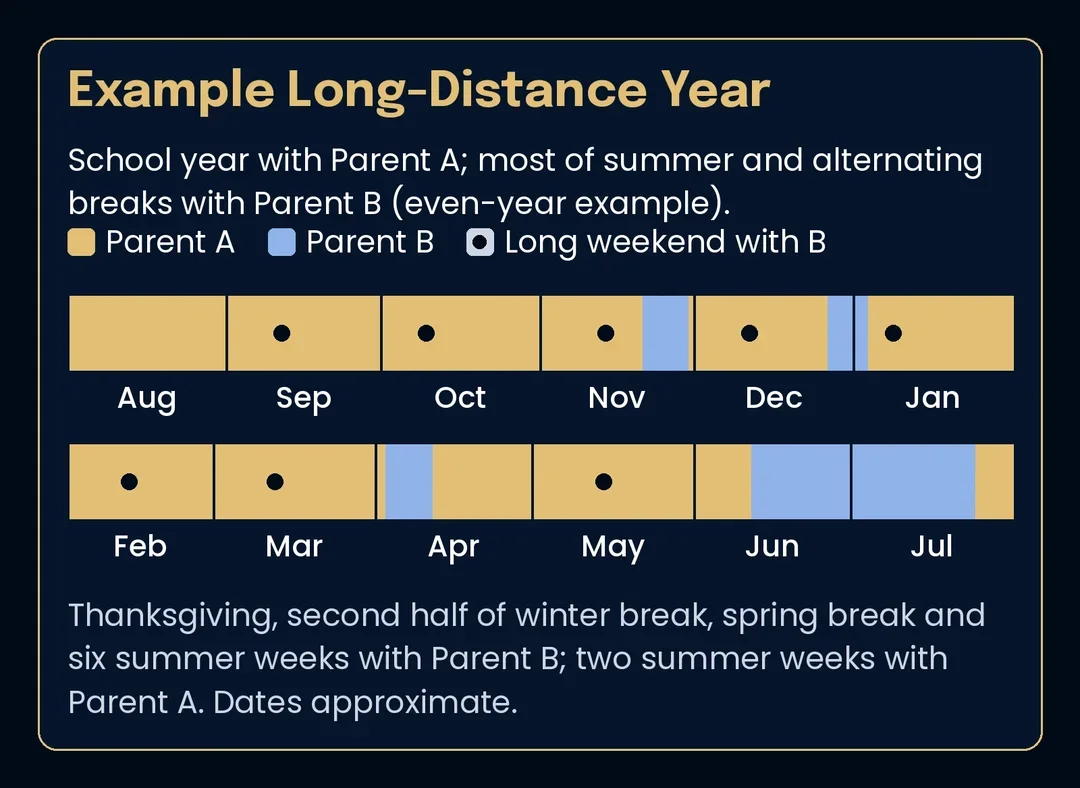
A sample year might look like this:
| Period | Parent A (child's school home) | Parent B (distant parent) |
|---|---|---|
| School year | Primary residence | One long weekend per month in A's city or B's home |
| Thanksgiving | Odd years | Even years |
| Winter break | First half even years | First half odd years |
| Spring break | Odd years | Even years |
| Summer | Two weeks | Six weeks |
The table is an illustration, not a standard.
Virtual Visitation
Family Code section 3100(f) defines virtual visitation as "use of audiovisual electronic communication tools to provide contact between a parent and their children as part of a parenting plan or custody order." The statute also states it may be supervised or unsupervised, depending on the court's determination of the child's best interest.
In practice, parents write video-call schedules into the plan: for example, three calls a week at a set time, with flexibility around school and activities. Judicial Council form FL-341 (Child Custody and Visitation (Parenting Time) Order Attachment) includes a space for virtual visitation alongside in-person time, and the optional FL-341(D) (Additional Provisions—Physical Custody Attachment) has a section for scheduled telephone contact. Fixed times make calls predictable for the child and reduce disputes.
Calls With the Parent Who Is Away
Between visits, phone and video calls carry much of the relationship. The Family Code sections reviewed for this article (3020 through 3105) do not set a daily call, a call length or which parent dials; section 3100(f) recognizes "virtual visitation" and leaves whether it is supervised to the court's best-interest determination. The specifics come from the parenting plan or order.
The optional Additional Provisions—Physical Custody Attachment (form FL-341(D)) has an item titled "Phone contact between parties and children" with three checkboxes:
telephone access between the children and the parties "at reasonable times, for reasonable durations";
a written schedule for which "the custodial parent must make the child available"; and
a term stating that "No party or any other third party may listen to, monitor, or interfere with the calls."
Terms parents often spell out when they write a schedule: a set call window (for example, 7:00 to 7:30 p.m. on school nights), an expected length, who places the call, whether video counts, and what happens when a call is missed because of an activity or time-zone difference. A window set around homework and bedtime is easier for a child to keep.
Travel and Transportation Terms
Distance makes travel the biggest line item and the most common source of friction. The plan should address:
Who travels and how. Whether the child flies, who accompanies a younger child, and the airline's policies for unaccompanied minors.
Cost. How airfare and other expenses are shared. Family Code section 4062(b)(2) lists "Travel expenses for visitation" among the items a court "may order" as additional child support.
Exchange points. Which airport or meeting place, and who is responsible for each leg. FL-341 has lines for who provides transportation and where exchanges occur.
Travel restrictions. An order may require written permission from the other parent or a court order before a child is taken out of California or out of named counties.
Our article on traveling with your child after a California divorce covers travel permissions in more detail.
Notice Before a Move
Long-distance schedules often begin with one parent's relocation. Under Family Code section 3024, when making a custody order the court may require a parent to notify the other before changing the child's residence for more than 30 days, unless there is a prior written agreement. The notice is to be sent by mail, return receipt requested, and, to the extent feasible, at least 45 days before the proposed move so there is time to mediate a new agreement. The optional FL-341(D) attachment includes a matching provision for notice of a child's planned move by certified mail.
Whether a parent may relocate with a child is its own legal question; see move-away custody cases in California.
When Abduction Risk Is Raised
Distance, especially international distance, can raise concerns about a child not being returned. Under Family Code section 3048(b), when the court becomes aware of facts that may indicate a risk of abduction, it must decide whether preventive measures are needed. If so, the court must consider measures such as supervised visitation, a bond, restrictions on removing the child from the county, state or country, surrender of passports, and requiring the traveling parent to provide an itinerary and round-trip tickets.
Pros and Cons by Age
Family Code sections 3020 through 3105 do not tie long-distance schedules to age; their only references to a child's age concern the child's wishes (sections 3030(c)(1) and 3042). These are practical considerations.
Infants and toddlers. Long blocks away from a primary caregiver can be hard for very young children, so plans often rely on the distant parent traveling to the child for shorter, more frequent visits, plus regular video calls. See our infant and toddler guide.
School-age children. The school-year/summer split is common at this age. Children can usually manage longer summer blocks and solo-flight logistics as they grow.
Teenagers. Summer jobs, sports and friendships can compete with a long summer away. Plans often become more flexible, and a teen's preferences may be considered under Family Code section 3042.
How California Courts View Long-Distance Plans
The court applies the same best-interest framework as in any custody case. The child's health, safety and welfare are the primary concern under section 3020(a), and state policy favors frequent and continuing contact with both parents under section 3020(b). Distance does not change those principles; it changes the tools available to carry them out. If parents disagree, the contested issues are set for mediation under section 3170(a). For how a long-distance plan compares with the local rotations, see our 50/50 custody schedule guide.
Keeping the Distant Parent Involved Day to Day
Beyond calls and visits, distant parents can stay part of ordinary life. Shared access to school portals and medical records, joining parent-teacher conferences by video, and receiving copies of report cards all help. Under the main custody attachment, FL-341, both the custodial and noncustodial parent have the right to access records and information about their children, including medical, dental and school records, and to consult with professionals serving the children. Our article on equal access to child records explains the underlying law.
Key Takeaways
Fixed times for video calls make virtual contact predictable for the child.
Travel cost, escorts and exchange airports should be spelled out rather than left to case-by-case negotiation.
An order can require advance notice of a child's move, ideally 45 days where feasible.
Where abduction risk is shown, the court must consider protective measures such as passport surrender.
FAQs
Can virtual visitation replace in-person time?
It is a tool within a parenting plan, not a standard substitute. Whether and how it is used depends on the child's best interest.
Who pays for travel in a long-distance custody schedule?
Parents can allocate travel costs in their agreement. In a child support order, Family Code section 4062(b) states that the court "may order" "Travel expenses for visitation" as additional child support; it is listed as discretionary, unlike the mandatory items in section 4062(a).
What if one parent wants to move away with the child?
Relocation is decided separately under California's move-away law. See our move-away article for how those cases work.